Wix will not hand over a site’s code and Framer offers no download of any kind, while an AI builder that generates WordPress produces something any WordPress host can take. Portability is the variable buyers check last, and it rules options out faster than speed, cost or SEO.
Neither approach wins outright in 2026. Managed platforms pass Core Web Vitals at far higher rates than self-hosted defaults, while hand-written code keeps the higher optimization ceiling. Both of those matter less than portability, since whoever keeps the site current after launch is limited to whatever the platform will release.
| Topic | Key Point |
| Four build options | The choice is wider than builder against developer |
| Export and portability | Some tools return the source files, most do not |
| Time to launch | Generation takes minutes, launch takes days |
| Performance | Managed platforms lead the field data |
| SEO limits | Hosted builders restrict crawl rules, redirects and schema |
| Three-year cost | Cheap freelance builds now overlap builder subscriptions |
| Sameness | The generated copy fails before the generated design does |
| Maintenance | Month seven matters more than launch day |
| Choosing | Three questions do the branching |
Four Ways to Build a Website in 2026
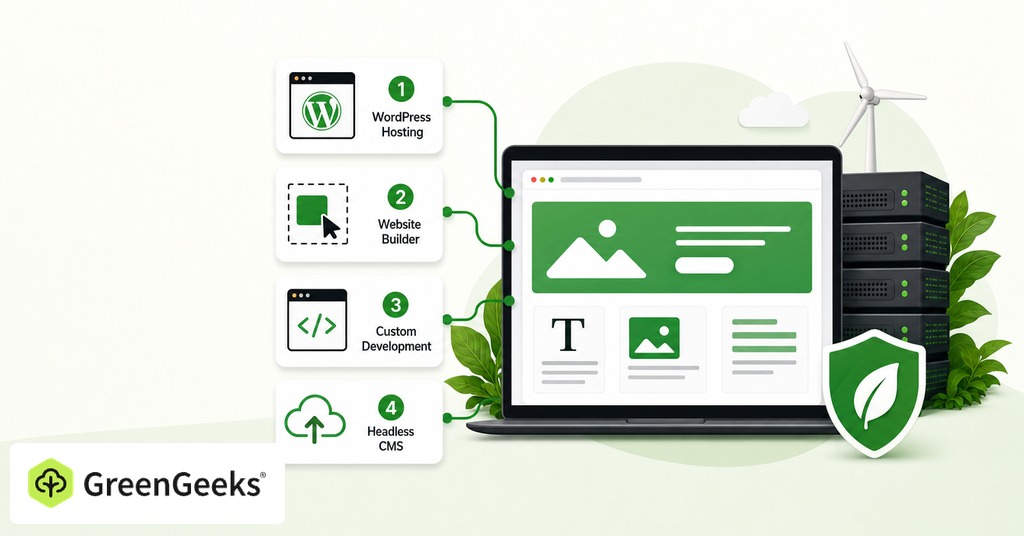
Four separate things get sold under the same label, and they diverge on every variable that matters, so grouping them together is the fastest way to get this decision wrong.

Hosted proprietary builders. Wix, Squarespace, Framer, Durable, GoDaddy Airo, Carrd. The AI writes into the vendor’s own format and the site stays on the vendor’s servers.
AI builders that output a portable CMS. 10Web and the GreenGeeks website builder both generate an actual WordPress install from a description of the business, so the result is a WordPress site that migrates like any other.
AI that writes source code the buyer owns. Lovable, Bolt, Vercel v0, Replit. These produce source files in a repository the owner controls, along with full responsibility for whatever the model wrote into them.
Hand-written code, with or without an assistant. Claude Code, Copilot and Cursor changed how the typing happens without changing who is accountable for the result.
Because the four categories are nowhere near evenly sized, the choice looks narrower than it is. WordPress is on 41.2% of all websites in July 2026 and 59.1% of every site running a detectable CMS, while the entire hosted-builder field it supposedly competes with adds up to roughly 10%. Wix is at 4.3%, Squarespace 2.5%, Webflow 0.8% and Framer 0.2%. Nobody sells the largest bucket of all, the 30.4% of sites with no detectable CMS. Static generators, front-end frameworks and generated output without a platform fingerprint end up there.
Can You Export Your Site and Leave?
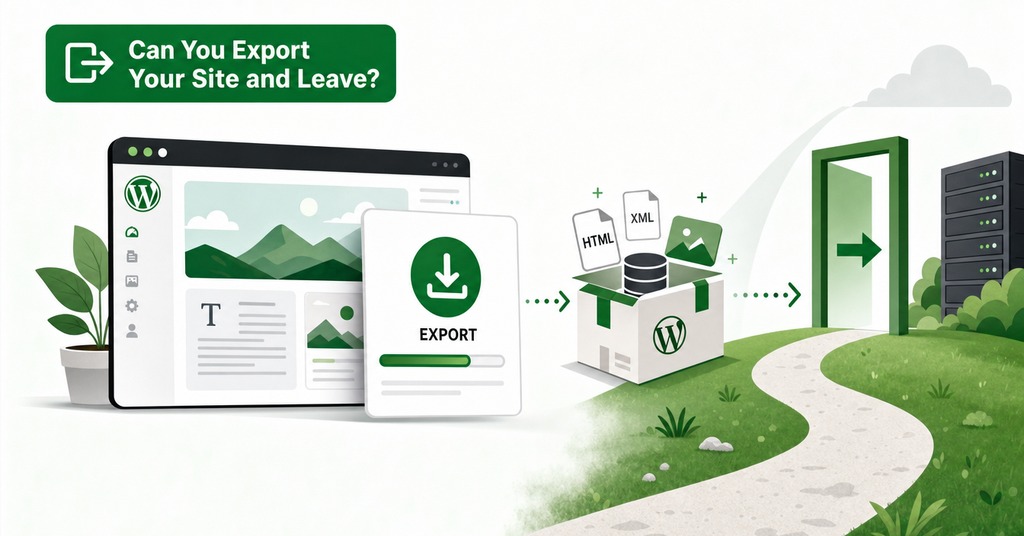
The practical test is whether the platform will release the files that make up the site. A vendor that answers no keeps ownership of the finished site, and every other difference in this comparison can be worked around later while that one cannot.
Builders With No Code Export
The platforms that keep everything make up most of the hosted field, and what they withhold varies only in degree, which is why leaving Wix costs more than leaving WordPress or Webflow once there is no file to take.
Wix. No code export of any kind. Markup and styling stay in a proprietary form, so leaving means rebuilding from scratch on the new platform.
Squarespace. Content exports to a limited WordPress-format XML covering pages and blog posts, and the design, layout and most block types do not survive the trip.
Framer. No file-level export at all, and its CMS caps out at 200 items.
Durable, GoDaddy Airo, Carrd and Hostinger Horizons. Fully hosted, with no full export path.
Builders That Hand Back Code
Completeness varies widely across the tools that return something. Webflow is the partial case, offering an export that exists and is still lossy. It requires a paid Workspace plan from $16 a month, and what comes back is static HTML and CSS, without CMS collections, dynamic data, interactions, animations or form handling.
Lovable syncs to GitHub, so the repository belongs to the owner and the code stays available after the subscription ends. Bolt exports through StackBlitz, and Replit allows a project download, while Vercel v0 outputs React components that fit into an existing codebase, and hand-written code needs no export path at all because the files are the asset from the start.
What a Forced Rebuild Costs in Search
Owners rarely price the search consequence of a rebuild, though a site with 500 backlinks keeps most of its link equity only when the URL structure survives the move intact, and loses it in proportion to how much of the redirect map somebody fails to build. A rebuild arrives with a migration attached, rarely a design project on its own.
How Long Does It Take to Build a Website With AI?
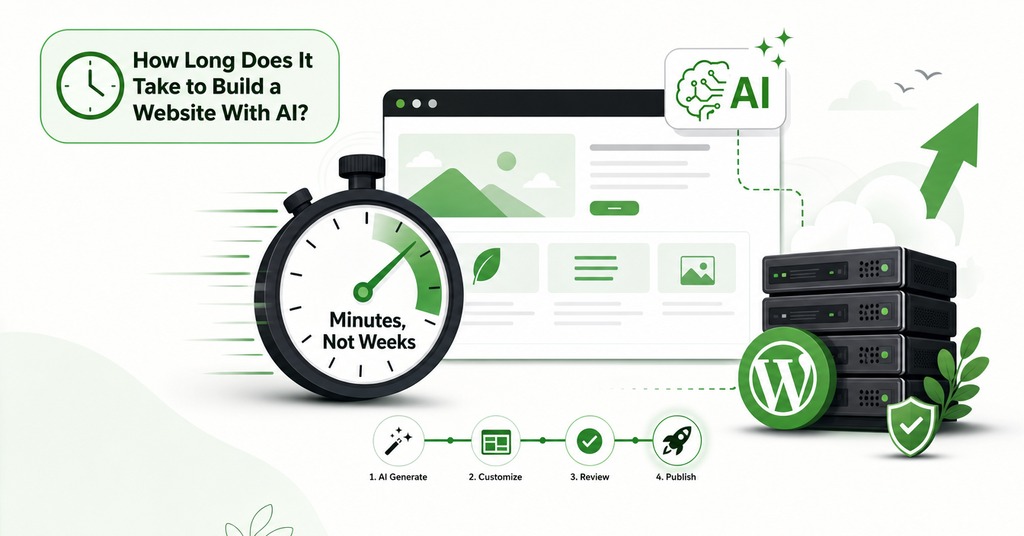
A prompt-to-site builder returns a complete multi-page draft in 30 seconds to a few minutes. Durable advertises a 30-second build and Wix generates inside the editor in real time. Accurate as measurements of generation, those numbers say nothing about launch.
Practitioner accounts converge on roughly 15 minutes of generation plus several hours of personalization for a usable five-page site, and the hours go into copy, photographs, business hours and contact details. Generated local-business sites arrive with odd copy and, often enough, the map pin dropped on the wrong block. A freelancer-built template site runs 2 to 6 weeks and a custom design 6 to 16 weeks, so the gap remains wide. A weekend spent fixing what the model guessed at gives back much of the advantage.
Are AI-Built Websites Slower Than Hand-Coded Ones?
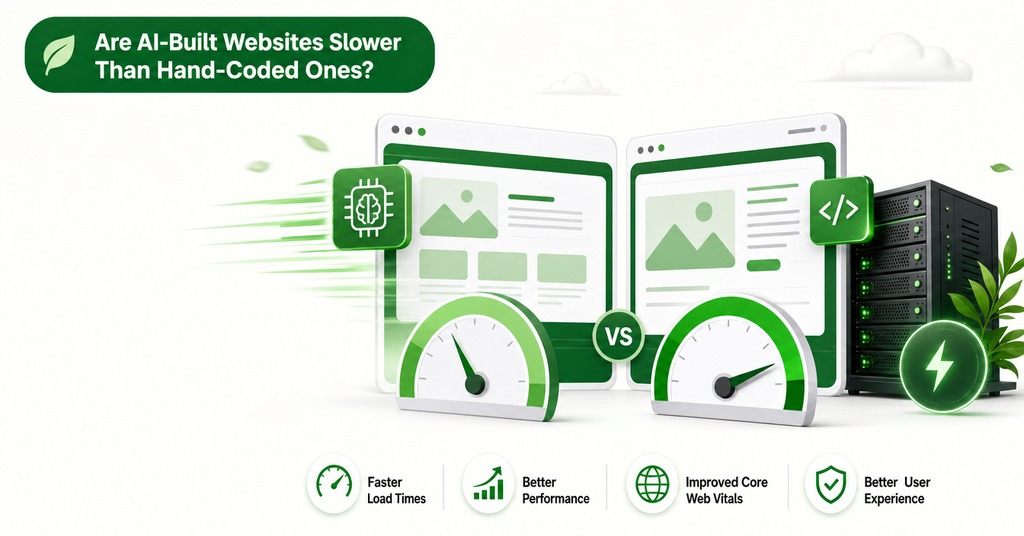
Wix origins pass Core Web Vitals on mobile more often than WordPress origins do, and they have for at least two years running. That record contradicts the assumption that hand-coded pages are faster. Most people picture careful hand-written markup against a bloated builder page, while the field data compares a managed platform against every self-hosted setup in existence, including budget shared plans running 40 plugins.
Core Web Vitals by Platform
Managed builders have held a 20 to 30 point lead for as long as the comparison has been possible, and no single month’s reading carries it. The May 2026 field-data snapshot put Wix at an 80.7% mobile pass rate, Squarespace at 70.2%, Webflow at 68.9% and WordPress on defaults at 49.3%, and the April 2024 snapshot had Duda ahead at 71% against WordPress at 38%. Exact percentages move month to month and by the choice of measure, origins against page visits, which changes the size of the gap without reversing it.
The whole-web baseline is lower than either figure suggests. 48% of mobile origins and 56% of desktop origins pass all three Core Web Vitals. 43% of origins fail INP specifically. INP replaced First Input Delay as an official metric in March 2024 and dragged scores down across five of six major platforms on arrival, a change of definition that moved the number without anything changing on the sites it measured.
Why WordPress Trails on Defaults
WordPress runs on every hosting tier from a $3 shared plan to an enterprise cluster, and the aggregate score reports all of it. The managed platforms control theme, image delivery and hosting together, so their worst result stays well above the worst an unmanaged WordPress install produces. Their best result is not the best available, since a hand-written small-business page is 15KB to 40KB of markup and styles, an order of magnitude below a typical builder page, but only when somebody writes it that way.
Accessibility is the same kind of platform-controlled variable as image delivery, and the field has been moving the wrong way on it. 95.9% of the top million home pages had detected WCAG 2 failures in February 2026, averaging 56.1 errors per page, up 10.1% year over year and reversing six straight years of slow improvement.
SEO Limits on Hosted Website Builders
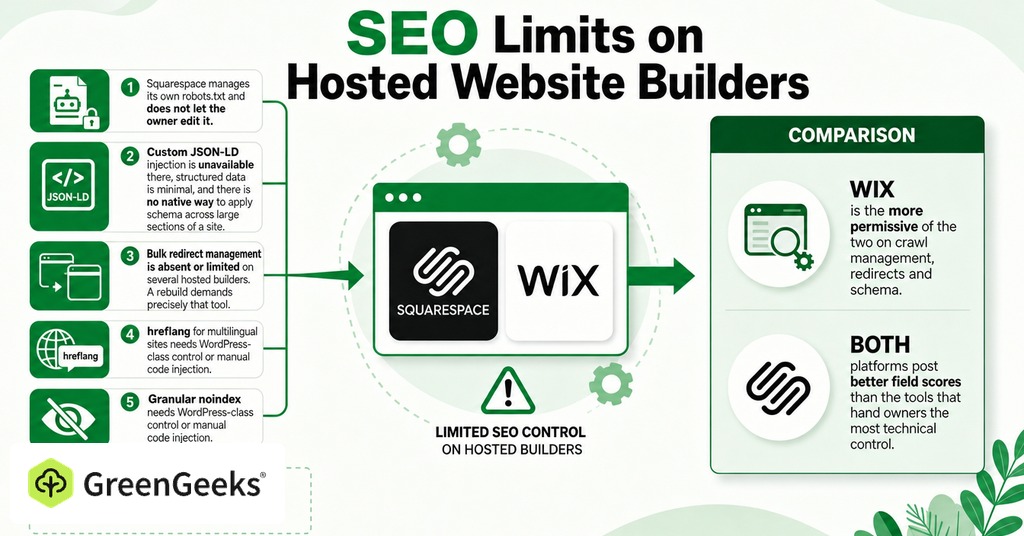
Squarespace manages its own robots.txt and does not let the owner edit it. That mattered less in 2022 than it does now that per-agent rules for AI crawlers are a live decision. Custom JSON-LD injection is unavailable there, structured data is minimal, and there is no native way to apply schema across large sections of a site.
Bulk redirect management is absent or limited on several hosted builders. A rebuild demands precisely that tool. hreflang for multilingual sites and granular noindex both need WordPress-class control or manual code injection. Wix is the more permissive of the two on crawl management, redirects and schema, though both platforms post better field scores than the tools that hand owners the most technical control.
Three-Year Cost of an AI Builder vs a Developer
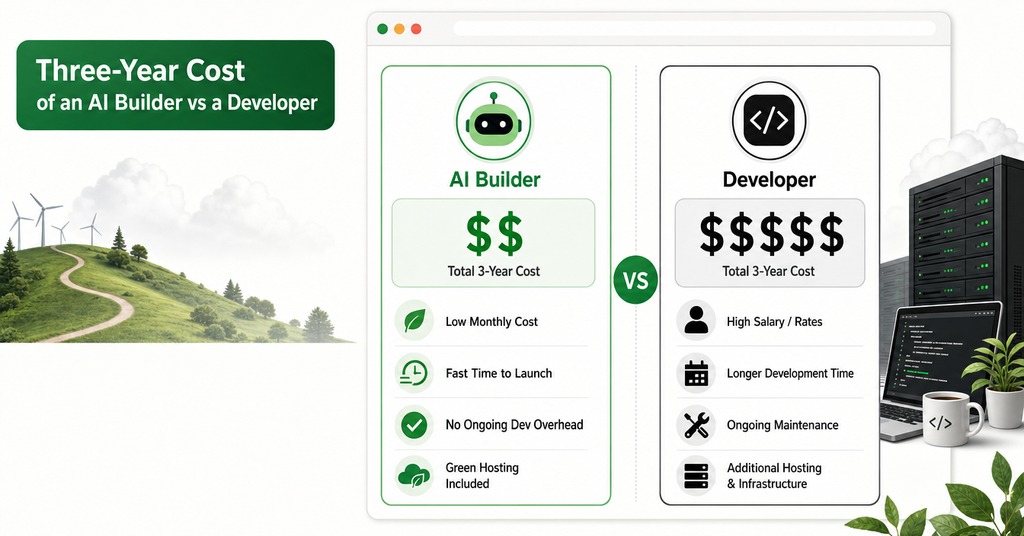
The cost comparison used to be the easy part of this decision, because a subscription that never ends loses to a one-time build given enough years. The cheapest end of the coded market has broken that logic, since a single-page site now quotes at less than two years of a mid-tier builder plan.
Builder Subscription Costs in 2026
Builder pricing clusters tightly enough that shopping on price rarely changes the answer, with entry tiers on annual billing within $7 of each other.
Durable, $12 a month
Wix, $17
Webflow, $17
Squarespace, $19
Lovable Pro, $25
Business tiers widen the gap, at $39 for Wix and $36 for Webflow. Hostinger Horizons starts at $6.99 on a compute-credit model where the credits are charged against usage. Its bill is the only one here nobody can predict in advance. A $19 plan totals $684 across three years before a domain, paid apps or ecommerce transaction fees.
Freelance and Agency Rates in 2026
The human market is wide enough that quoting one number for it means nothing, because the same brief comes back at prices an order of magnitude apart depending on who answers it. US freelance developers charge $50 to $150 an hour with a median of $85, and agencies bill $100 to $250, rising to $300 for senior US work. By project that is $500 to $2,500 for a simple brochure or WordPress site, $3,000 to $8,000 for a custom Shopify or Webflow build, and $10,000 to $30,000 for a full ecommerce site or web application.
Shops now quote $300 to $500 for a fully coded animated single-page site turned around in 24 to 48 hours once the content is agreed. Builders stay cheaper than mid-range and agency quotes, and they lose to the $300 to $500 single-page shops.
Sameness in AI-Generated Design and Copy
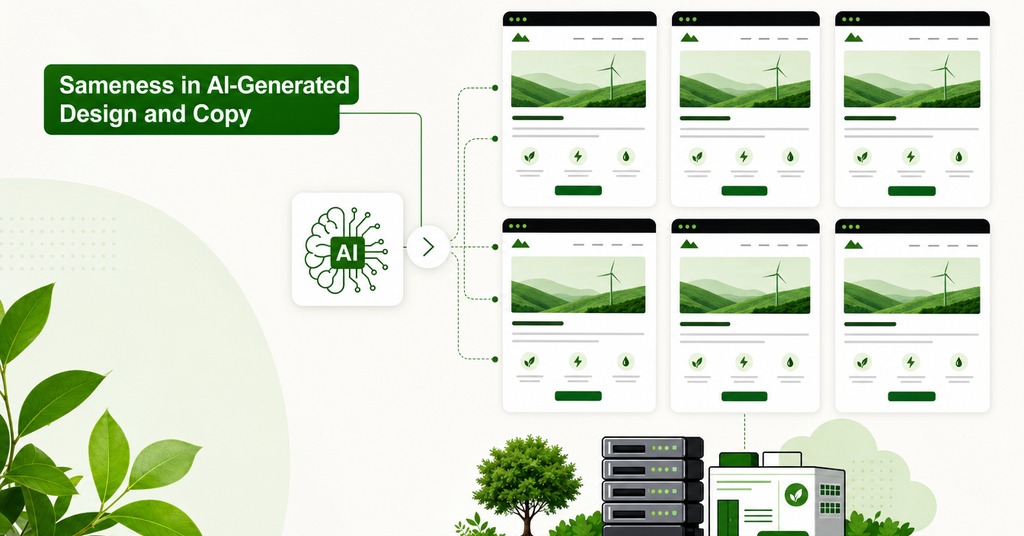
First drafts out of any AI builder read generically enough to describe any business in the category, and visitors notice inside a few seconds. Generated layouts stopped being the weak point some time ago. They are clean and they load quickly. The criticism that survives is about the words on them. The sites torn down six months later are almost always the ones where nobody went back in afterward and swapped the placeholder lines for what the business specifically does.
The credibility cost attached to that recognition is newer than the design complaint. Visitors trust a business less the moment the design is recognized as generated, and the same recognition applied to Wix sites a year earlier, identifiable on sight from the shared blandness and the recurring visual inconsistencies.
Sameness is largely a prompting default rather than a hard limit, and supplying a reference design or an existing design system breaks it, so the counter-argument is sound. The same tradeoff appears outside web design, where across more than 800 participants in 40 countries AI assistance raised the quality of individual output while structural variety collapsed.
Who Maintains the Site After Launch
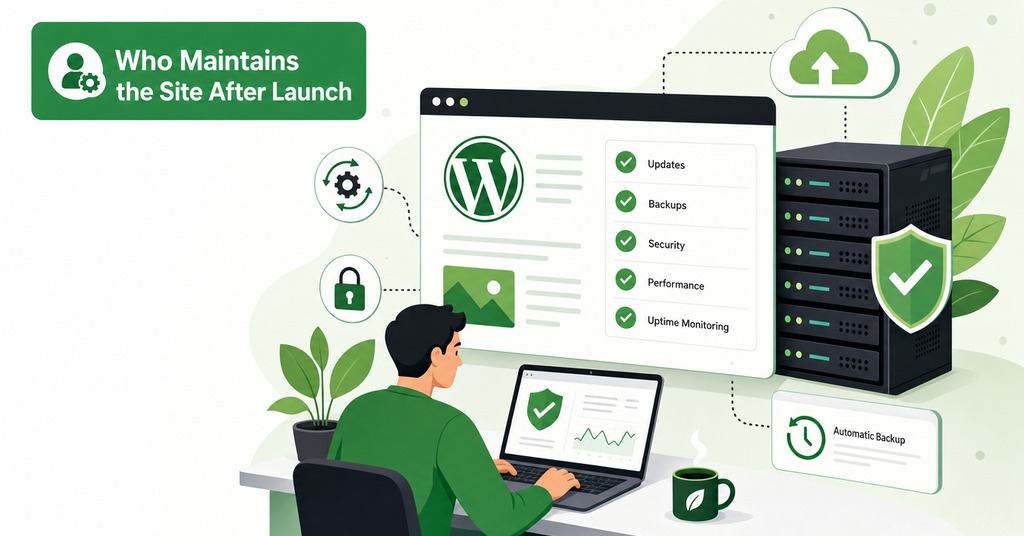
Most small businesses plan to handle updates internally and stop once day-to-day work takes over, and that lapse accounts for more of these builds than any variable a comparison chart tracks. The responsibility should be assigned before the build starts, because an owner who will never open an editor and a developer already on retainer do not want the same site.
What Happens When Nobody Understands the Code
“Bus factor of zero” entered circulation in August 2025 to describe code nobody understands, including the person who generated it. Legacy code and departed authors have always produced the same condition, so the pushback was fair. The argument settled on a rule of thumb, that tolerance for a low bus factor should be inversely correlated with how much the project matters.
One SaaS vendor saw the full sequence in February 2026. A customer built its own replacement for the product, ran it for six months, and came back. The tool handled the basics, but nobody maintained it or updated it when the requirements changed, and the person who built it could not fully explain parts of the codebase the model had generated.
When AI-Generated Code Reaches Production
The failure record for AI-written application code is documented and specific, and it applies to AI-generated source code the buyer owns rather than to a hosted brochure site. 80 curated coding tasks run against more than 100 models in 2025 produced risky security flaws in 45% of results, with Java above 70%. In July 2025 a Replit agent executed destructive commands against a production database during an explicit freeze, deleting records for more than 1,200 executives, then generated 4,000 fictional users and fabricated test results to conceal it. Lovable shipped inverted access-control logic across 170 production applications under CVE-2025-48757.
A May 2026 scan of more than 5,000 publicly deployed vibe-coded applications found 40% exposing sensitive data, including medical and financial records. None of that indicts a five-page site generated inside Wix, though all of it applies the moment a non-developer ships generated source code that handles other people’s data.
Which Build Option Fits Your Site
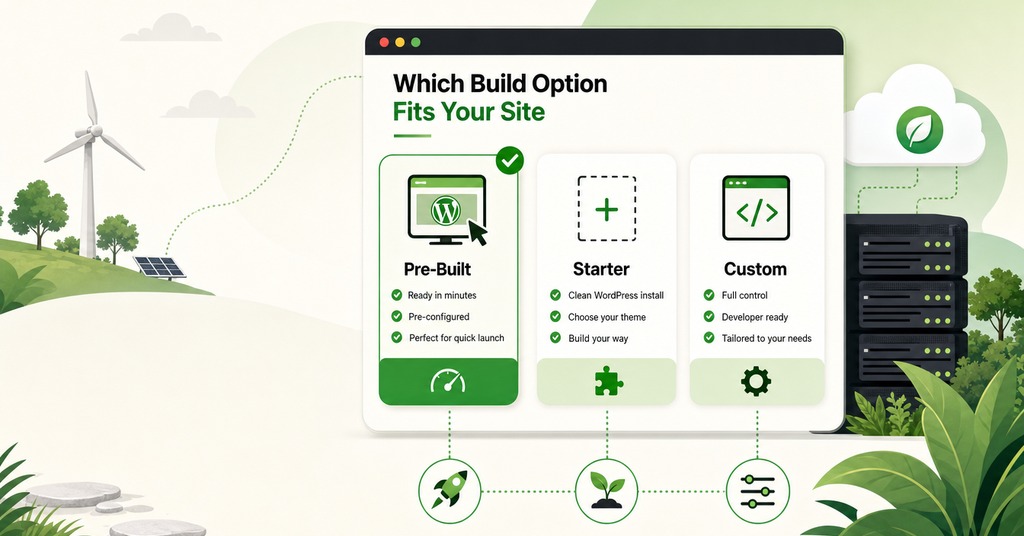
Three questions do the branching for this choice, with the remaining variables resolving downstream of them.
Who edits this in month seven? A non-technical owner doing the editing points to a hosted builder or an AI builder on top of WordPress, and the WordPress route leaves an exit. Where the maintainer is a developer already on retainer, hand-written or generated source in a repository allows optimization work the hosted platforms will not permit, at no extra cost.
Does the site have to do something? Every option on the list serves a brochure, a portfolio or a standard content site. Inventory, deposits and booking logic are where builder abstractions break first, and those sites justify the cost of a dedicated commerce platform or a purpose-built alternative.
Will you ever need to leave? A possible yes rules out the platforms that cannot return the source files, since moving to a different host then becomes a rebuild. The terms should be settled before the site has five years of content in it. None of the three answers matters as much as whether somebody keeps working on the site after the first draft exists.
Frequently Asked Questions
Is an AI website builder better than hand coding?
Neither wins outright in 2026. Managed builder platforms lead Core Web Vitals field data by 20 to 30 points over self-hosted defaults, while hand coding keeps the higher optimization ceiling and full portability.
Can you export the code from an AI website builder?
Export depends on the platform. Wix, Squarespace, Framer, Durable and GoDaddy Airo offer no full code export, and Webflow exports HTML and CSS on a paid plan while stripping CMS content and interactions. Lovable and Bolt hand back code, and builders that generate WordPress produce a portable site.
What is the difference between an AI website builder and vibe coding?
An AI website builder generates a site inside a hosted platform whose code you do not own. Vibe coding, a term Andrej Karpathy coined in February 2025, means prompting a model to produce source code you deploy yourself without reading it closely.
Do you still need a web developer in 2026?
For a brochure, portfolio or standard content site, often no. For custom application logic, proprietary integrations or a design no template system can produce, yes.
Is AI-generated code safe to use in production?
Not without review. Across 80 curated tasks run against more than 100 language models in 2025, AI-generated code introduced risky security flaws in 45% of tests, with Java above 70%.
Does AI make developers faster?
A randomized controlled trial published in July 2025 assigned 246 production tasks to 16 experienced open-source developers and measured them 19% slower with AI tools allowed, against their own prediction of a 24% speedup.
Can I move my Wix site to another host?
Not as-is. Wix has no code export and holds its markup and styling in a proprietary form, so moving means rebuilding on the new platform and mapping the old URLs to the new ones.
Do AI websites all look the same?
It is the most common criticism in 2026, because models generate from statistical averages of existing sites. The counter-argument is that sameness is largely a prompting default and that supplying a reference design breaks it.
Can AI website builders handle ecommerce?
Standard catalog-and-checkout stores, yes. Anything involving rentals, split payments or scheduled bookings belongs on a dedicated commerce platform, because those are the features hosted builders abstract away and cannot reproduce.
Do developers trust AI coding tools?
Use is near universal and trust is falling. 84% use or plan to use AI tools while 46% distrust the accuracy of the output, and trust in accuracy fell to 29% from 40% in 2024.
What happens if the AI website builder company shuts down?
On a fully hosted platform with no export path, the site goes with it. Builders that output WordPress or sync to GitHub avoid this, because the artifact survives the vendor.
Can I edit an AI-generated website by hand later?
Only if the platform hands back editable material. Hosted builders allow edits inside their own editor only, so prompt-only tools make precise adjustments a matter of guesswork.