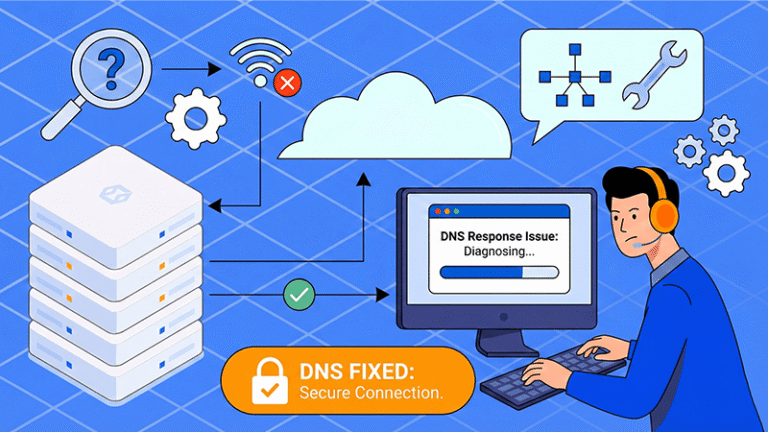
 Why Business Emails End Up in Spam
Email is critical for invoices, customer communication, marketing, and system notifications. However, many businesses face a silent issue: emails land in spam even when everything appears correct. As a result, this disrupts communication, reduces trust, hurts conversions, and damages brand credibility. Contrary to popular belief, this problem is rarely caused by email content. Instead, in most cases, server-level configuration and reputation issues are the real reason emails fail to reach inboxes.
How Email Providers Judge Your Emails
Mail providers like Gmail, Outlook, Yahoo, Zoho, and corporate servers use automated filters to evaluate every email before delivery. First, these systems assess IP reputation and domain authentication. Next, they verify DNS alignment, server trust, encryption standards, and overall sending behavior. If even one technical factor fails, emails are automatically marked as suspicious and redirected to spam—often without any visible error to the sender.
IP Blocklisting: A Hidden Threat to Email Deliverability
One of the most common reasons for spam placement is a server IP with a poor or restricted reputation, often due to IP blocklist listings. In many cases, blocklisting occurs silently and without any prior warning, making it difficult to detect until email delivery is already affected. As a result, when an IP appears on spam monitoring blocklists, inbox delivery can drop instantly.
This risk is especially high on shared servers, where a single compromised or misconfigured account can negatively impact hundreds of domains. Consequently, businesses often become aware of the problem only after customers report missing or undelivered emails.
SPF, DKIM, and DMARC Errors
Email authentication plays a critical role in inbox placement. Without proper configuration, missing or misconfigured SPF, DKIM, or DMARC records signal possible spoofing to mail providers. Even small issues such as multiple SPF records, unsigned DKIM messages, or a weak DMARC policy can significantly reduce delivery rates. Unfortunately, these problems often persist unnoticed for months.
Reverse DNS (PTR) Problems
A valid reverse DNS (PTR) record is required to establish email trust. Without it, sending servers immediately appear suspicious to mail providers. Moreover, if the PTR record does not match the sending hostname, inbox placement becomes extremely difficult regardless of other configurations.
Poor Server Reputation and Sending History
Mail servers closely track long-term sending behavior. For example, high bounce rates, spam complaints, malware infections, or sudden spikes in sending volume can severely damage sender reputation. Once trust drops, emails are filtered aggressively even when authentication checks pass successfully.
Outdated SSL/TLS Email Security
Modern email delivery requires strong, secure encryption. Therefore, servers using outdated TLS versions, weak ciphers, or broken certificates quickly lose trust with receiving mail servers. As a result, some providers reduce inbox placement, while others reject connections entirely.
Open SMTP Relays and Unauthorized Sending
Misconfigured SMTP relays allow unauthorized scripts or users to send spam through your server. As a consequence, even small abuse incidents can permanently damage domain and IP reputation, making inbox delivery nearly impossible without professional cleanup.
High Bounce Rates and Poor List Quality
Sending emails to invalid or non-existent addresses signals spam-like behavior to mail providers. As a result, high bounce rates quickly reduce sender trust and harm future inbox placement. Unfortunately, many businesses ignore bounce logs until deliverability is already severely impacted.
Low Engagement Signals
Mail providers continuously evaluate user interaction to determine inbox placement. For instance, emails that are ignored, deleted, or never opened gradually lose priority. Over time, low engagement signals poor relevance and pushes even legitimate emails into spam folders.
Irregular Email Sending Patterns
Sudden spikes in sending volume, long inactivity periods followed by mass campaigns, or highly inconsistent schedules immediately raise red flags. In contrast, legitimate businesses typically send emails at a steady, predictable pace. Therefore, irregular sending behavior is often treated as suspicious by mail providers.
Hosting and DNS Configuration Errors
Expired SSL certificates, outdated MX records, DNS misalignment, failed migrations, and routing errors can all cause emails to be flagged as unsafe—even when nothing appears wrong on the surface.
Our Email Deliverability Audit Service
Complete Server-Level Email Audit
We identify and fix the root causes of spam placement by performing a full technical audit, including:
- Live IP reputation and denylist tracking
- SPF, DKIM, and DMARC verification
- Reverse DNS (PTR) validation
- SSL/TLS security review
- Server reputation analysis
- Sending pattern assessment
- Malware and unauthorized relay detection
Once these issues are resolved, inbox placement improves dramatically even on strict providers like Gmail and Outlook.
Ongoing Deliverability Optimization
We don’t just fix problems we prevent them. Our optimization process includes:
- Clean list management guidance
- Bounce and error monitoring
- Authentication alignment
- Gradual IP warming strategies
- Engagement-focused sending practices
This ensures long-term inbox stability and improved sender reputation.
Dedicated IP Setup for Maximum Control
For businesses sending critical or high-volume email, we offer dedicated IP configuration. Dedicated IPs eliminate shared-server risks and give you full control over sender reputation, with proper warming to ensure safe delivery.
Monitoring and Reputation Tracking
We configure professional monitoring tools to track:
- Spam complaint rates
- Domain and IP reputation
- Authentication performance
- Delivery errors and warnings
Early detection prevents customer-visible email failures.
Why Choose Us
- Server-level expertise (not generic email advice)
- Proven inbox recovery methods
- Works with Gmail, Outlook, Yahoo, Zoho, and corporate mail servers
- Transparent reporting and fixes
- Long-term deliverability improvement, not temporary patches
Fix Your Email Deliverability Today
If your business emails are landing in spam, the problem is almost always technical and completely fixable. A professional server-level audit restores inbox placement, improves trust, and ensures your emails reliably reach customers and partners.
👉 Contact us today to restore inbox delivery and protect your email reputation.